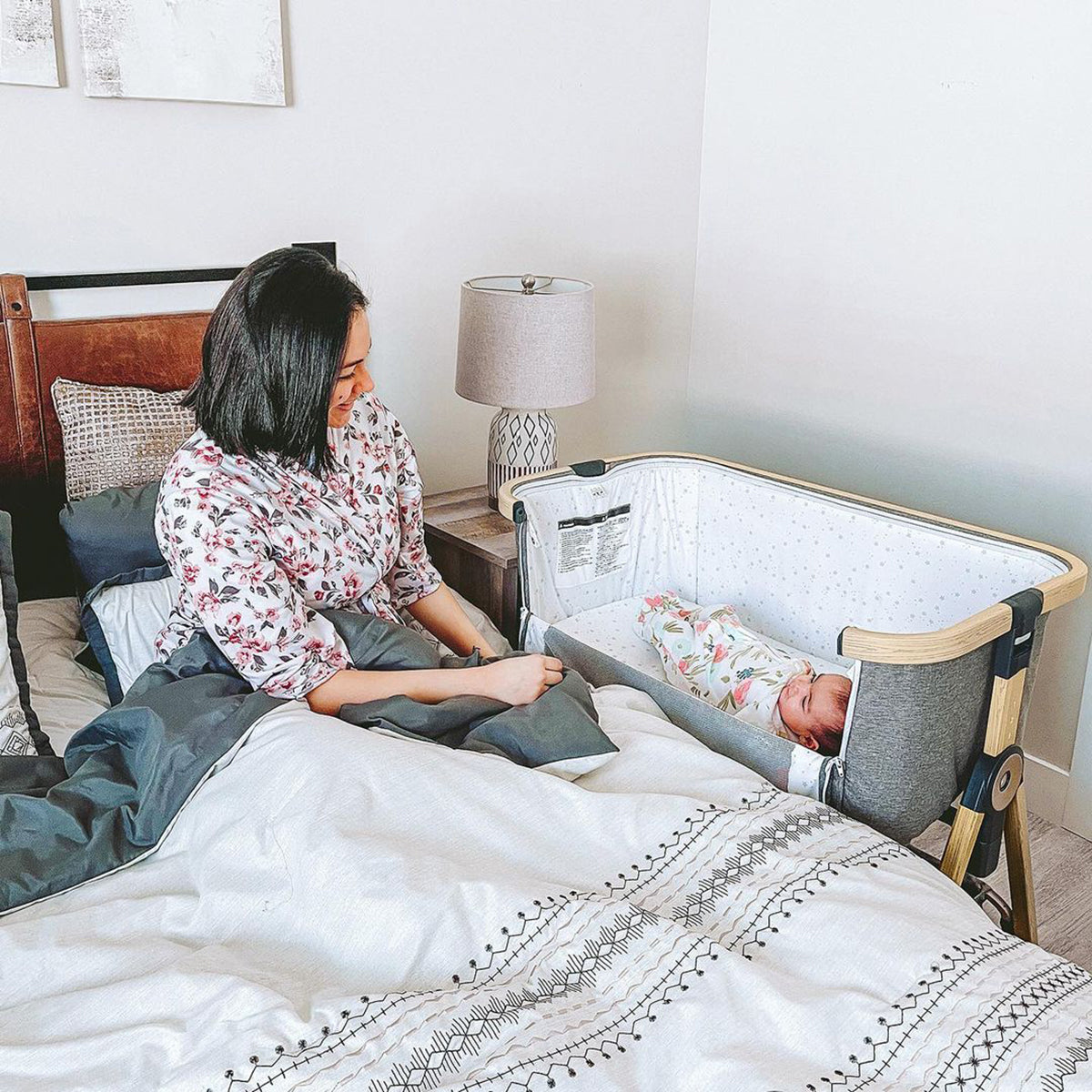
A crib with an attached changing table may look like the perfect nursery shortcut. It combines two major pieces of furniture, keeps diapers close to the sleep area, and often costs less than purchasing a crib and changing station separately.
A separate changing table offers a different kind of value. It can be positioned wherever diaper changes are easiest, may provide a larger work surface, and can often be moved, replaced, folded, or repurposed without affecting the crib.
The better choice depends on more than whether a combination unit is “worth it.” Parents need to compare the actual room layout, changing-surface dimensions, safety limits, expected years of use, conversion costs, storage needs, and how the nursery may change as the baby grows.
This guide compares crib-changing table combinations with separate changing tables across space, safety, comfort, lifespan, flexibility, and long-term cost.
Quick Comparison: Combo Crib vs. Separate Changing Table
| Category | Crib With Changing Table | Separate Changing Table |
|---|---|---|
| Initial floor space | Usually uses less total floor area than two full-size pieces | Requires a second furniture location |
| Wall length | Often creates one long, heavy furniture footprint | Pieces can be placed on different walls or in different rooms |
| Changing surface | Often narrower or shorter | Usually available in more sizes and heights |
| Layout flexibility | Changing station is fixed to the crib | Can be moved independently |
| Upfront cost | May cost less than two comparable pieces | Can cost more, although budget and portable options exist |
| Long-term use | Crib may last years, but the changer may be outgrown much earlier | Changing table may be reused as storage or moved to another room |
| Replacement flexibility | A damaged or inconvenient section may affect the entire unit | Each item can be repaired or replaced separately |
| Best for | Compact nurseries with a suitable continuous wall | Families prioritizing flexibility, ergonomics, and longer reuse |
What Is a Crib With a Changing Table?
A crib with a changing table is one connected furniture unit that combines an infant sleep space with a raised diaper-changing surface. The changer is usually attached to one end of the crib and may include drawers, shelves, cabinets, or a removable pad.
Many models are also marketed as convertible cribs. Depending on the design, the crib may later become a toddler bed, daybed, or full-size bed. The changing section may remain attached, detach as a small nightstand, or become general storage.
These details vary significantly. A “4-in-1” or “5-in-1” label usually describes the bed configurations rather than the number of separate furniture pieces included. Conversion rails, bed frames, mattresses, and hardware may be sold separately.
What Counts as a Separate Changing Table?
A separate changing station can take several forms:
- A traditional standalone changing table
- A dresser with an approved changing tray or attachment
- A compact or portable changing table
- A foldable model that can be stored when not in use
- A secure changing pad used on an appropriate low surface
The defining difference is that the changing station is not permanently connected to the crib. It can be positioned, moved, replaced, or retired without changing the baby’s sleep furniture.

Space Comparison: Floor Area Is Only Part of the Decision
Combination furniture is often described as space-saving, but square footage alone does not tell the whole story. Parents should also measure usable wall length, door clearance, drawer access, walking paths, and whether the unit can be turned or repositioned.
How a Combo Unit Saves Space
A crib-changing table combination usually occupies less total floor space than a full-size crib plus a full-size standalone changing table. It may work well when the nursery has one long uninterrupted wall and limited space for additional furniture.
It can also reduce the number of separate furniture legs, gaps, and small spaces that collect clutter.
Why a Combo Can Still Feel Large
Although the total area may be smaller, the unit itself is wider than a standard crib. It may not fit between a closet and doorway or along a wall broken up by windows, vents, or built-in storage.
A long combination crib can also be difficult to:
- Carry through doorways after assembly
- Rotate inside a narrow room
- Move between bedrooms
- Position beside a parent’s bed
- Rearrange when the nursery later becomes a toddler room
Why Separate Pieces Can Work Better in an Irregular Room
Separate furniture requires more total space but can use areas that one long unit cannot. The crib may fit on the safest uninterrupted wall while the changing table sits beside a closet, near the bathroom, or in the parents’ room.
Parents with a very small newborn setup may temporarily use a 3 in 1 bassinet crib near the bed and place the changing station in another convenient area before transitioning to a full-size crib.
Measure These Areas Before Buying
- The full assembled width, depth, and height
- The space needed to open every drawer and cabinet
- The distance between the furniture and doors
- The width of the room’s doorway and hallway
- The location of electrical outlets, cords, windows, and vents
- The caregiver’s standing space in front of the changing surface
- The route used to carry the baby between feeding, changing, and sleep areas
Mark the dimensions on the floor with removable tape. This shows whether the furniture fits without blocking movement and can reveal that a “space-saving” unit would dominate the room.
Safety Comparison: Both Options Require Hands-On Supervision
A combination design is not automatically safer because the changing table is connected to a crib. A standalone table is not automatically safer because it has four separate legs. Safety depends on construction, installation, barriers, restraints, dimensions, condition, and correct daily use.
Safety Requirements to Check
For either type of changing product, look for:
- A stable structure that does not wobble
- A changing surface intended for infant diapering
- Protective barriers around the usable surface
- A working restraint system when one is provided
- Clear weight, length, age, or developmental limits
- A pad that fits the product correctly
- Complete hardware and readable instructions
- No recall, broken component, or missing attachment
Use the safety strap, but never treat it as permission to step away. Keep one hand on the baby and place diapers, wipes, clothing, and cream within adult reach before beginning.
Do Not Improvise the Changing Pad
Combination cribs often use a smaller or proprietary changing surface. A standard changing pad may hang over the edge, interfere with barriers, or fail to fit the attachment points.
Use only the pad size and attachment method permitted by the manufacturer. Avoid adding thick cushions, loose towels, pillows, or pads that make the protective sides effectively lower.
Keep Changing Supplies Out of the Crib
The crib and changer are two separate functional areas even when they share one frame. Wipes, creams, diapers, plastic packaging, clothing, toys, and changing pads must not enter the sleep space.
Open shelves beside the crib can make supplies easy to reach, but parents should check whether an increasingly mobile baby can reach through the crib slats and pull items inside.
Check the Entire Unit After Conversion
When a combo crib is converted, removed components and new hardware can change its stability. Follow the exact instructions for the chosen configuration and do not leave unused openings, exposed hardware, loose rails, or an unsupported changing section.
Changing Surface Size and Baby Growth
One of the most important differences is the amount of usable changing space. Attached changers are commonly smaller because they must fit beside the crib without making the entire unit excessively large.
A small surface may work well during the newborn months but become inconvenient as the baby grows longer, kicks more strongly, rolls, and reaches for nearby supplies.
Before purchasing, compare:
- The usable interior length and width
- The manufacturer’s maximum weight
- The stated developmental limits
- The height of the surrounding barriers
- Whether the baby can reach drawers or shelves
- Whether the required pad is widely available
Do not assume that the changing section can be used for as long as the crib. The bed and diapering surface have separate limits.
The Lifespan Mismatch
A convertible crib may remain useful through the toddler years or longer. Its attached changer may serve the family for a much shorter period.
This creates a lifespan mismatch:
- The crib may remain structurally useful for years.
- The changing surface may be outgrown during infancy or early toddlerhood.
- The attached storage may remain useful even after diaper changes move elsewhere.
- The unused changer may continue taking up room if it cannot detach.
Before treating a convertible combination as a long-term purchase, check what happens to the changer in every future bed configuration.
Questions to Ask About Conversion
- Does the changing table detach completely?
- Can it become a nightstand or small dresser?
- Must it remain attached to the toddler or full-size bed?
- Are conversion rails included?
- Can the required kit still be purchased several years later?
- Does conversion require a new mattress or bed frame?
- Where will removed parts be stored?
Lifespan of a Separate Changing Table
A standalone table also has a limited period for elevated diaper changes, based on its manufacturer’s limits and the child’s development. Its advantage is what happens afterward.
Depending on the design, it may become:
- Toy or book storage
- A standard dresser
- A bathroom organizer
- General household shelving
- A changing station for a younger sibling
- A resale or donation item independent of the crib
A foldable changing table may have less furniture-style reuse, but it can be stored or moved when elevated changes are no longer convenient.

Ergonomics: Fixed Height vs. Personal Fit
Parents may perform thousands of diaper changes, so working height matters. A surface that is too low can lead to repeated bending, while one that is too high may strain the shoulders and make it harder to control an active baby.
A combination crib gives parents little control over changing height. The height is determined by the attached design and cannot usually be adjusted independently.
Separate models offer more choice. Parents can compare several heights or use a properly designed dresser-based changing station that better fits the primary caregiver.
Test the Working Position
Stand in front of the display model or mark the listed height against a wall. Imagine:
- Lifting a growing baby onto the surface
- Keeping one hand on the baby
- Reaching for supplies without twisting
- Fastening clothing near the baby’s feet
- Using the station after childbirth or during back discomfort
A slightly larger footprint may be worthwhile if the separate table provides a safer and more comfortable working position.
Storage Comparison
Combination Crib Storage
Combo units may include open shelves, drawers, cabinets, or under-crib storage. This can keep essential items close together and reduce the need for another dresser.
However, check:
- Whether drawers open fully without hitting a wall
- Whether shelves remain accessible as the child grows
- Whether supplies can be reached from the changing position
- Whether the attached storage is large enough for clothing
- Whether the unit can be anchored or stabilized as instructed
Separate Table Storage
Separate changing tables usually offer greater variety. Parents can choose open shelves for visibility, drawers for concealed storage, wheels for mobility, or a compact design for basic supplies.
Families comparing different diapering setups can also review this guide to choosing a changing nappy table.
Upfront Cost vs. True Long-Term Cost
A combo unit may have a lower initial price than purchasing a crib, dresser, and changing table separately. That does not guarantee the lowest total cost.
Possible Combo Costs
- Crib-changing table unit
- Crib mattress
- Proprietary changing pad or replacement cover
- Toddler rail
- Full-size bed rails or frame
- Future replacement changing station if the surface is outgrown early
- Professional assembly or moving costs
Possible Separate Furniture Costs
- Crib
- Crib mattress
- Changing table, dresser attachment, or portable model
- Changing pad
- Wall anchoring hardware when required
- Future crib conversion kit
Use a True-Cost Worksheet
| Cost Question | Combo Unit | Separate Setup |
|---|---|---|
| Initial furniture cost | Record purchase price | Add both furniture prices |
| Required mattress and pad | Add all required sizes | Add all required sizes |
| Conversion hardware | Add every kit not included | Add crib kit if applicable |
| Replacement risk | Consider whether an early-outgrown changer requires another purchase | Consider whether either piece can be replaced independently |
| Reuse or resale value | Estimate value of the full connected unit | Estimate each item separately |
The lower-cost choice is the one that supports the family’s actual use period without forcing an unplanned second purchase.
Flexibility and Future Room Layout
Nursery needs change rapidly. The room may later need space for crawling, toys, a toddler bed, sibling furniture, or a home office.
A separate changing table can move to another wall or room. It can also be removed while the crib stays in place.
A fixed combination unit limits these choices. Even after the changing function ends, the attached section may determine where the bed fits and which wall remains usable.
Who May Prefer a Crib With a Changing Table?
A combination model may be a good choice when:
- The nursery has one suitable long wall.
- Total floor area is limited.
- The attached changer is large enough for the expected use period.
- The working height is comfortable.
- The storage can replace another dresser.
- The changer detaches or converts usefully later.
- The family accepts a more fixed room layout.
- The full package costs less after adding conversion parts.
Who May Prefer a Separate Changing Table?
A separate model may be better when:
- The room has several small usable spaces instead of one long wall.
- Caregivers want a larger changing surface.
- Working height is a major concern.
- The changing station needs to move between rooms.
- The crib may later be moved to another bedroom.
- The family wants to replace or resell items separately.
- A dresser or storage unit is needed after diapering ends.
- The attached changer on available combo models is too small.
A Five-Step Decision Test
- Measure the room. Compare total floor area and usable wall length.
- Check the changer dimensions. Do not judge from product photographs.
- Read every limit. Treat crib and changer limits separately.
- Add future costs. Include mattresses, pads, rails, frames, and replacement furniture.
- Plan the room after diapering. Decide whether the attached changer will still be useful.
Common Buying Mistakes
- Assuming every combo is compact: Some require more uninterrupted wall space than separate furniture.
- Comparing only purchase prices: Add conversion kits, mattresses, pads, and future replacements.
- Ignoring changing-surface measurements: Attached changers may be smaller than expected.
- Assuming the changer lasts as long as the crib: Each function has separate limits.
- Buying a replacement pad without checking fit: Use the approved size and attachment method.
- Forgetting drawer clearance: Measure the furniture with storage fully open.
- Leaving supplies near the crib mattress: Keep the infant sleep area completely clear.
- Depending on the safety strap alone: Keep one hand on the baby and never step away.
Final Thoughts
A crib with a changing table can reduce total floor space, simplify the initial furniture purchase, and keep newborn supplies within reach. Its limitations are the fixed layout, smaller changing surface, potential ergonomic mismatch, and the possibility that the changer will be outgrown long before the bed.
A separate changing table usually requires more room and may cost more initially. In return, it offers greater flexibility, more size and height choices, independent replacement, and stronger potential for reuse after diapering ends.
Measure the room and the actual changing surface, review the separate limits for both functions, and calculate every required future purchase. The best option is the one that remains safe and practical throughout the period your family expects to use it—not simply the model with the lowest price or the greatest number of advertised conversions.
FAQ: Crib With Changing Table vs. Separate Table
Does a crib with a changing table save space?
It usually uses less total floor area than a full-size crib and separate full-size table. However, it requires one long furniture footprint and may not fit well in a room with doors, windows, or short wall sections.
Is a crib-changing table combo safe?
It can be safe when it meets applicable standards, is assembled correctly, uses the approved changing pad, and remains within all manufacturer limits. Use the restraint when provided, keep one hand on the baby, and never leave the baby unattended.
How long can you use the attached changing table?
The usable period depends on the model’s weight, length, age, and developmental limits. Do not assume it lasts as long as the crib or rely on a general age rule.
Are separate changing tables larger?
Many standalone tables offer a larger changing surface, but dimensions vary. Compare the usable interior area rather than only the furniture’s outside dimensions.
Is a combo crib cheaper than separate furniture?
It may be cheaper initially, especially when it replaces a crib, changer, and some storage. Calculate the mattress, changing pad, conversion kits, bed rails, and possible future replacement changer before deciding.
Can the changing table detach from a combo crib?
Some models allow the changer to detach or convert into storage, while others keep it permanently attached. Confirm every future configuration before purchasing.
What happens when the baby outgrows the changing surface?
Stop using the elevated surface according to the manufacturer’s limits. Diaper changes can move to a suitable separate station or a safe low surface while the crib continues to be used.
Which option is better for a small nursery?
A combo may work best when the room has one long usable wall. Separate compact or portable pieces may work better when the available space is divided across several smaller areas.